03
Projects & Feedback
Practical work, submitted from a phone if needed, returned with specific comments rather than a mark.
The Afghan Geeks Learning Platform
Most coding platforms assume a fast connection, steady power, and a laptop you don't have to share. We built ours assuming you may have none of those — because that was never a reason to fall behind.
Low-bandwidth live classes · No camera ever required

0.1 Mbps · camera never required
Why We Built Our Own
We did not set out to build software. We set out to teach — and ran into three walls that no product on the market was designed to handle.
No campus
Afghan women are barred from school beyond grade six and from university. For our students this platform is not an addition to a classroom — it is the classroom, the attendance register, and the record of what they achieved.
No bandwidth
On a real Afghan connection a shared screen turns to a blur at the exact moment the code matters. Students don't leave because they stopped caring. They leave because they can no longer read the lesson.
No camera
For many of our students, being seen on video is the reason permission to study is refused at home. Every platform we looked at made the camera the default and treated "off" as a compromise.
So we built the platform ourselves, around those three facts.
Afghanistan's internet could not carry a real-time coding class. So our own graduates built a classroom that could.
A standard online classroom sends a video of someone's screen. Video is heavy, and when the connection weakens the picture degrades first — so the code, the one thing a student came for, becomes unreadable exactly when she can least afford to lose it.
This is the quiet reason many well-meaning coding programs lose students here. Not a lack of will to learn, but a classroom that was never built for the connection our students actually have.
So we stopped sending video, and started sending the code itself.
live.afghangeeksedu.org/room
liveThe Live Code Room during a class
40×
The difference
Per student. It is the reason a class keeps running when the signal drops — and the reason a student on a shared connection is not the one who has to leave.
The code is the first thing to blur.
The code stays sharp — there is no picture to degrade.
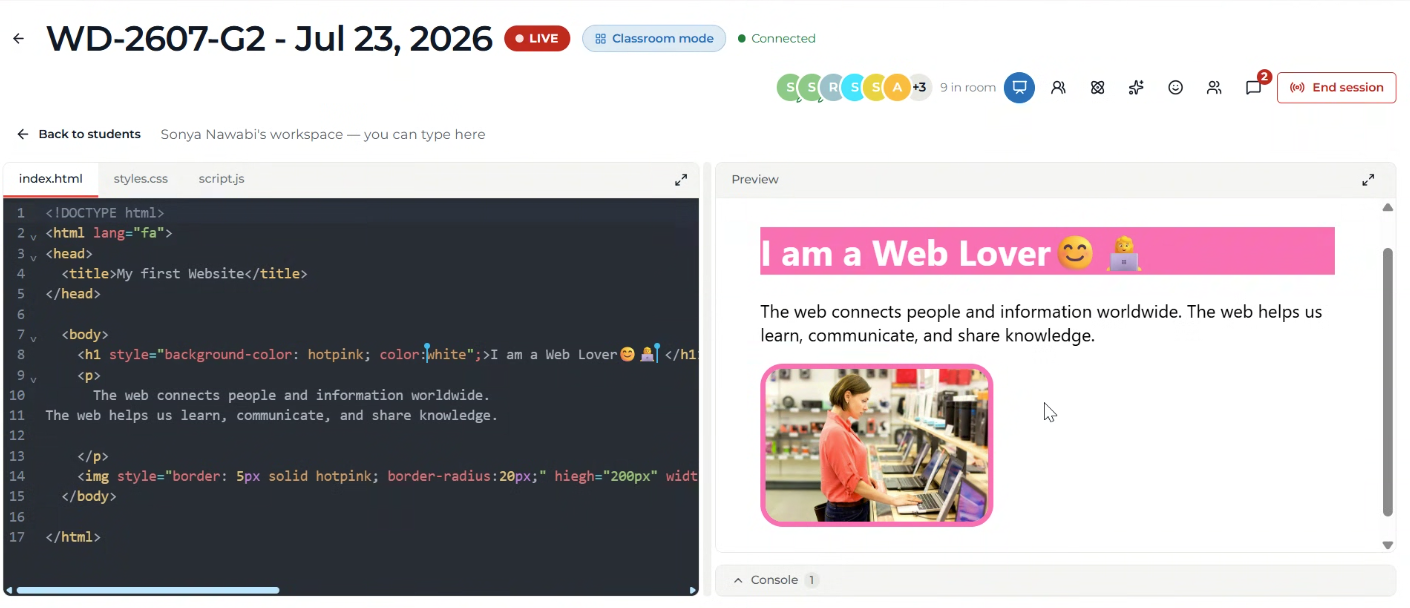
The classroom sends code as light, readable text rather than video of a screen. It stays sharp on a connection that would reduce a normal video class to a blur.
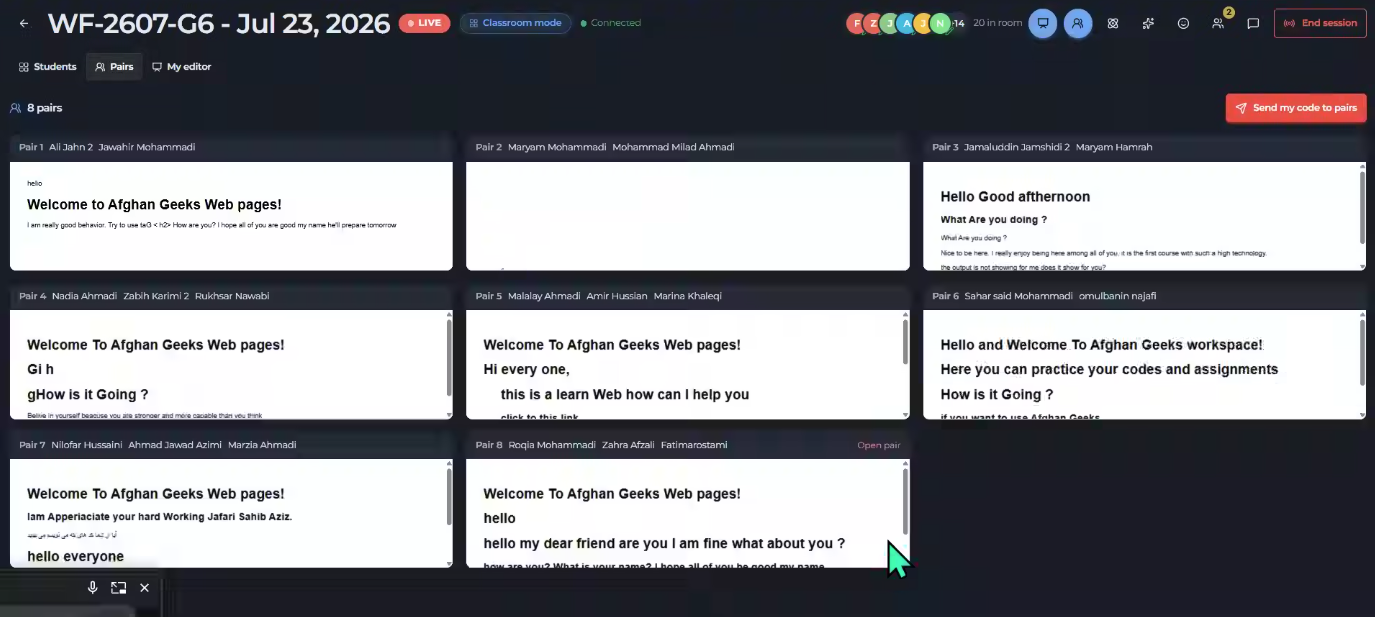
Students type in the same room as the instructor, run what they write, and get help in the moment the mistake happens — not in a comment three days later.
Class runs on voice and shared code. There is no camera to turn off, because there was never one to turn on — which is often what makes permission to study possible at all.
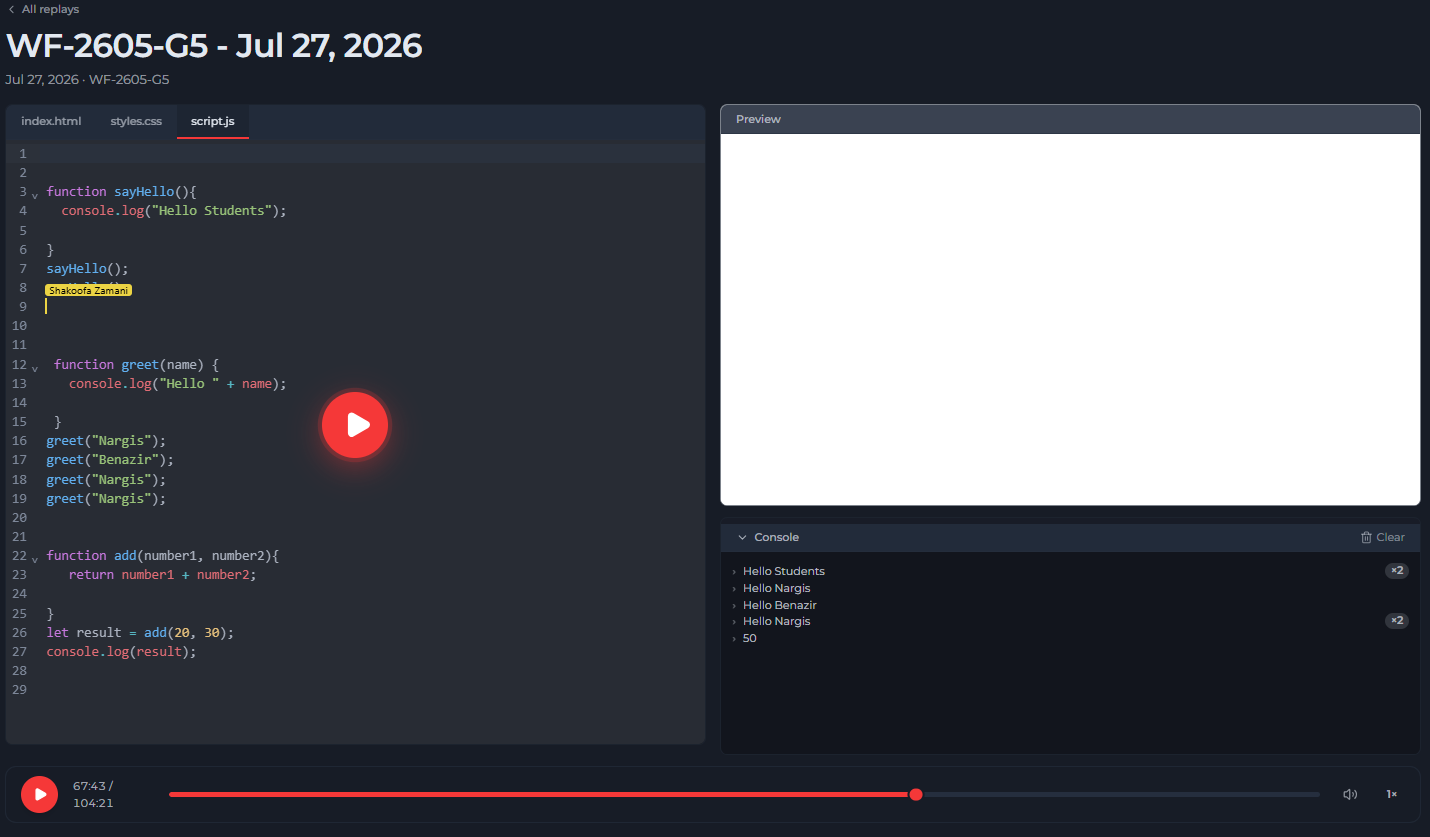
Power cuts and outages are not rare events here; they are the normal week. Every lesson is saved as a replay she can pause and try herself, and every session's code lands in her dashboard.
Low bandwidth was not a setting we added at the end. It shaped what the classroom sends, how lessons are stored, and why a student can keep working from a phone when the laptop is charged, borrowed, or gone. We maintain it ourselves, so every fix we make for one cohort is already there for the next.
The voice quality is wow — this is much better.
— a student, live class of 17
One Platform, Two Experiences
Class times, the code from last week, the project due Thursday, the grade that came back — all in one dashboard, so a student who missed a week knows exactly where to restart.
A Closer Look
Real screens from inside a running class — not mockups.

Where every class happens. Clear on a weak connection, and readable on a phone.
No scattered links, no five different apps, no third-party tool that needs a VPN to open. One platform, built for one purpose.
01
Live nowReal-time sessions with Afghan instructors, built to stay readable when the connection drops.
02
Miss a class to a power cut and you can still take it — paused, repeated, at your own speed.
Practical work, submitted from a phone if needed, returned with specific comments rather than a mark.
Built from the code taught in your own session, so practice matches the lesson you actually sat through.
Instant explanations when no one is awake to ask — reviewed by your instructor, never replacing her.
Ask, answer, and learn in the open, so studying at home doesn't mean studying alone.
An honest record of what you attended and what you earned — the transcript no institution will issue you.
Slides, guides, and the code from every session, kept where you can reach them.
Step 01
Send your application, get accepted into a cohort, and open a dashboard that is ready on day one.
Step 02
Code alongside Afghan instructors in real time — and replay anything you missed.
Step 03
Apply each lesson to real work, and get specific guidance on every project you submit.
Step 04
Finish with practical skill, an attendance and grade record, and proof of what you built.
Step 05
Turn your projects into a portfolio an employer can judge, wherever they are in the world.
Your career in tech starts here
This platform was not purchased or outsourced. It was designed and built by women who first arrived here as students, in a country that had told them their education was finished.
They knew the problem from the inside — the weak connection, the shared laptop, the camera that could not be turned on. That is why the platform solves those things properly, and why each cohort leaves it better than they found it.
This programme didn't just teach me to code — it changed what I believed was possible.
Sodaba
Started as Student, Web Development
Now: Frontend Developer
Khadija
Started as Student, Web Development
Now: Frontend Developer
A connection is enough. No campus to reach, no permission to be seen.
Classmates and instructors stay reachable between classes, not only during them.
Real projects from the first weeks, because employers ask what you made.
Finish with skill, a record of your work, and a portfolio that travels anywhere.
Behind every project finished, every graduate hired, and every woman who came back to join our team is one shared experience — this platform. Built by Afghan women, for Afghan women, and improved for whoever comes next.
